.jpg)
The Reserve Bank of India sold dollars via state-owned banks around 62.3575 per dollar to contain the rupee's fall, traders said.

Take a call to stay put or opt our based on whether you think the company will be able to find a strategic investor, suggests Sanjay Kumar Singh.
Because of local and global problems, inflation pressures may continue, helping these schemes perform better.

The move may release funds locked in government securities and add to liquidity. With inflation expectations lowered, this should not impact bond sentiment in the short run
With the merger between HDFC Bank and HDFC Ltd complete, analysts said the next key monitorable for the Street would be successful resolution of merger-related hiccups, including employee-related churn and roll out of complete banking services across branches. At the bourses, they expect the stock to perform in-line with the benchmark indices in the near-term. "There's usually an initial period of consolidation after a merger as the entities work towards integration.

So far this month, another $4.5 billion (Rs 33,000 crore) has flown into domestic stocks.

A home loan is a long-term contract, so do shop around before signing on the dotted line, advises Sarbajeet K Sen.
.jpg)
In New York market, the dollar lost ground against most major rivals on last Friday amid mixed US data on industrial production and consumer sentiment.

Invest in liquid funds if you have a horizon of three months, ultra-short-term for six months, and low-duration funds for one year.
.jpg)
Most Asian currencies weakened versus the dollar with the Thai baht and Philipine peso sliding on disappointing economic data.

Foreign investors have bought around $2.4 billion in both debt and equity so far in October, pushing the total inflows to nearly $36 billion so far in the year.
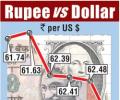
The previous bout of Fed withdrawal fears had threatened to spark a crisis of confidence in India -- sending the rupee to a record low of 68.85 in late August and leading to steep falls in bonds and stocks.

The Securities and Exchange Board of India (Sebi) on Monday relaxed the norms for valuing perpetual bonds. The norms, which had sought to value banks' deemed residual maturity of Basel III additional tier 1 (AT1) bonds as 100-year debt from April 1, were strongly opposed by the finance ministry. In a statement released on Monday, the regulator said the maturity would be 10 years until March 31, 2022, and would be increased to 20 and 30 years over the subsequent six-month period.
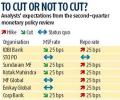
Analysts expect RBI to restore 100-bp corridor in Tuesday's policy review.

The Supreme Court on Tuesday said it will commence day-to-day hearing from August 2 on a batch of petitions challenging abrogation of Article 370 of the Constitution that bestowed special status on the erstwhile state of Jammu and Kashmir.

'Indian macro conditions have never been better, and many businesses will safely compound earnings over the next five years.'

The SIP route suits the salaried class, by matching their income flows with investment frequency.
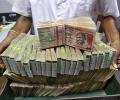
In New York market, the dollar fell further against the euro yesterday after minutes from the Federal Reserve's March meeting detailed risks that could keep interest rates depressed even after the first rate hike.

Domestic shares and other global markets rose on upbeat trade data from China earlier in the day and after a US House deal extending the federal borrowing authority.

The 'Angh' of Oting, Tahwang, is contesting the February 27 assembly polls on a Naga People's Front (NPF) ticket against the incumbent Bharatiya Janata Party MLA P Paiwang Konyak, who is a cabinet minister in the outgoing government.

With a 'yes' vote, there is a more foreseeable outcome, while a 'no' could result in greater uncertainty, for which retail investors may not have the appetite.

Exposure to debt funds and gold is essential even if current returns from these asset classes are low, suggests Sanjay Kumar Singh.

Investor mistakes are just too many and to me everything looks major. P V Subramanyam tells a few that bother and bug him as an investment advisor.

Experts believe FPIs will keep a close watch on coronavirus pandemic, its spread and likely impact on the economy while making decisions about investment into India.

In New York market, the dollar fell against the Japanese yen yesterday, taking cues from declines in US stocks.

You also avoid capital gains tax during redemption in case the gold price is higher, making them tax efficient.

'Both IIP and CPI inflation numbers are showing a huge disconnect from the leading indicators.'
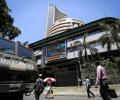
Bank Nifty pared all its intraday gains to end over 1% lower led by losses in BoB, ICICI Bank, Axis Bank and Bank of India

In the last few months, the 10-year G-Sec has been gyrating sharply and has crossed the 9-per cent-yield mark four times.

Banks are allowed to invest up to 10 per cent of the paid-up or unit capital in Category-I or Category-II Alternative Investment Funds

Market recovery on the cards in 2014 as investors are likely to chase higher yields

'It is going to be a tough balance for the RBI to manage economic stability and ensure smooth government borrowing.'

Total assets under management (AUM) for September stood at Rs 20.4 lakh crore compared with Rs 20.6 lakh crore at the end of August.

Be mindful that each instrument is governed by a different set of gifting rules and is also taxed differently.

The rupee had gained five paise to close at 63.25 against the dollar in on Monday's trade on fresh selling of the US currency by exporters amid bullish stocks.

Inflation pegs down currency value, re-allocates resources, reduces potential economic growth and leads to the attrition of gross domestic savings.

The partially convertible rupee closed at 61.31/32 per dollar, unchanged from its Tuesday close.

These schemes are expected to perform in the next 2-3 years.

'We will likely be buffeted by tailwinds from the global economy, geopolitical shifts and robust domestic demand.'

Indian bond yields may not spike if the government opts to increase spending when it unveils its annual budget in late February.
 © 2026 Rediff.com - Advertise with us - Disclaimer - Privacy Policy - Sitemap - Feedback - About us - Terms of use - Grievances